
Right now, somewhere, a buyer is asking an AI assistant the question you would most like to answer: who has actually used your product, service or solution, and did it work? The assistant replies with whatever evidence it can reach.
Whether yours is in that answer has surprisingly little to do with how good your stories are and your SEO.
The reader that doesn't browse
Someone new reads your customer stories first now, and it isn't a person. That linked guide covers the craft: structuring a story so an assistant can lift the relevant info cleanly, and cite you rather than paraphrase you.
Structure is half the job. The other half is reach. A well-structured story still depends on a crawler having read your site at some point, remembered it, and chosen to surface it later. That's like having your stories as library books; useful, if the reader borrows it. What AI assistants increasingly want is like a phone line: ask the question, get the current answer, cite the source.
A phone line for your evidence
The plumbing for that phone line exists, and it's called MCP; the Model Context Protocol. In plain English: MCP is a direct line for an AI assistant to query a live source, mid-conversation, instead of relying on what it remembers from training or can dig up in a web search.
Proofpoints publishes one of these lines for customer evidence. Any MCP-capable assistant can plug in and, live:
- ·search every published story by keyword, brand or industry
- ·pull the quantified proof points; just the numbers, each with its customer attached
- ·fetch the full text of any story
- ·grab the URL to cite, on every single result
This is not a mock-up; here it is connected to claude.ai, from nothing but a pasted URL:
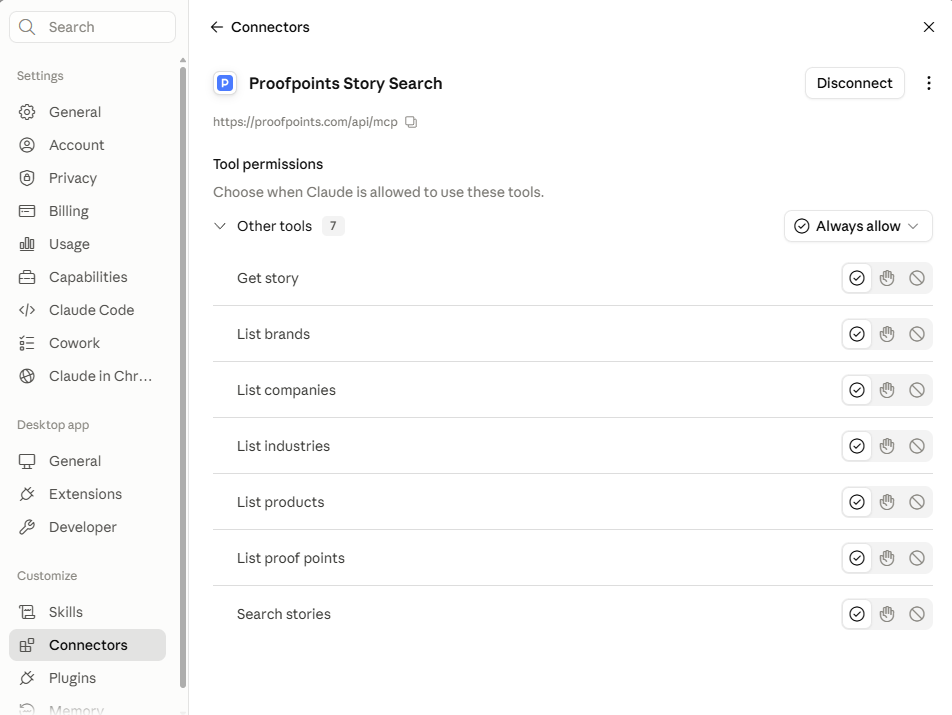
| Fig. 1 | The live connection in claude.ai: paste the address, get seven tools. No key, no login, no documentation required. |
Only published, public stories are reachable; every one reviewed and approved by the named customer featured in it. Read-only, no login, nothing private. If it isn't on the public site, it isn't down the line.
The stranger test
I wanted to know how this feels from the other side of the fence, so I ran a test as one of my clients, or their prospects would. I gave an AI assistant that had never seen Proofpoints the address of the endpoint and nothing else. No documentation, no walkthrough. Then I asked it to build me a working proof-search page.
It worked first time. Search, brand and industry filters, a numbers-only view, and every stat carrying a link to the story it came from. The page it built was workmanlike rather than beautiful, but that isn't the point.
First time success, with no help from us.
We've since built the more polished version ourselves. It runs on the same public endpoint, and every result on it is fetched live as you type:
| Read next | ||
| Proof search, live | ||
| Search the published library the way an AI assistant would; same endpoint, same data, watch the wire. | ||
|
What changes for your program
Your story library stops being a just a destination and starts being a source.
Your own team gets there first. A salesperson mid-deal can ask the assistant they already use for the right proof point; the specific number, the named customer, the product, the link, without trawling a folder or pinging you on a Friday afternoon.
Buyers' assistants answer with your evidence. When the question is "who has done this in logistics?", an assistant with a line to your library can reply with a real customer, a real number and the approved page behind both, instead of a paraphrase of something stale.
Attribution travels. Every result carries its URL, so the citation habit is built into the pipe. Nobody has to remember to link back; the link arrives with the number.
And the control that makes advocacy safe survives the trip. Nothing is reachable that the advocate didn't see and approve, so an assistant can only repeat what they signed off. The promise you made when you asked for the story holds all the way though this new tech.
Three things to do this quarter
Ask an assistant about yourself. Open whichever one you use and ask what evidence exists that your product works. If the answer is thin, wrong or someone else's blog, you've found the gap this guide is about.
Keep the evidence structured. Named advocate, numbers with labels, one stable URL per story. Machines can only carry what's cleanly packed; the citation guide covers this in detail.
Ask where your stories in real time what happens when an assistant knocks at your door. If your stories sit as PDFs behind a form, the honest answer is "nothing". Whatever platform holds your evidence, it's always good practice to search for customer evidence a a prospect would.
FAQ
What is MCP (Model Context Protocol)? An open standard that lets AI assistants query live data sources directly during a conversation, rather than relying on training data or web search. Proofpoints publishes a public MCP endpoint so any capable assistant can search published customer stories and cite the real URLs.
Can AI assistants see our private or draft content? No. The endpoint serves only stories that are published and public; exactly what the public website already shows. Drafts, private stories and everything inside your workspace are not reachable, and the endpoint is read-only.
How do I connect an AI assistant to Proofpoints? Point any MCP-capable assistant at https://proofpoints.com/api/mcp. No key, no login; it is read-only and rate-limited. In claude.ai, add it as a custom connector; other MCP clients accept the URL the same way.
Does this replace SEO for customer stories? No; it adds a second door. Search and answer engines still find and cite well-structured public pages. An MCP endpoint serves the growing share of questions answered live by an assistant, where being connectable matters as much as being indexed.